
Note: Herewith several related comments on the role of “proof” in the contemporary natural and human sciences. A critical comment on the title of a recently-published book by A. Aczel — which carries the confusing title Why science does not disprove God (2014) — is also included. The first of my comment deals with what it is that “scientific activity” produces. The heading “Science does not prove — but only declares” summarises my conclusion. In brief, that the outcome of scientific inquiries are a series of declaration on our current knowledge about “our world” which together constitute a comprehensive representation — a momentarily authentic picture of what the world is like.
 What is commonly understood by *submitting a proof* and its opposite, *submitting a disproof*? When someone submits a proof they are said to demonstrate to others how a conclusion they themself (privately) reached was obtained. More specifically, how they arrived at the conclusion by entirely logical means, and not by empirically demonstrations.
If they told us that they just “felt that the vase they had unearthed” was a Greek urn which had once contained the ashes of a fallen warrior, we would call it a “guess” but not a true discovery unless the claim was supported by much more evidence or provenance! If they “show” that something they had foretold had materialized, like that a gesture made towards heaven produced a hail of manna, that is not a proof, but only a demonstration: it shows that their prediction on this particular occasion worked! Such predictions were once made routinely by reputed “wise men” but none have been recorded reliably for the past few hundred years.
A proof, on the other hand, refers to a post-facto event which states that whatever was initially said about a matter followed logically from some earlier explicitly-cited assumptions. For example, that 2 of anything added to 3 results in 5 items. In this case there is no doubt about the existence of the numbers cited, or that the number 5 can be generated in a different ways. The assumptions may not be empirically true — often they are not! What we have here is a calculation which involves abstract, not empirically true events. Two goats standing in the meadow and three sheep grazing nearby make five animals. Contrast this to the claim made that “When I put a match to this spout of a bottle a flame will emerge”. The answer to the question “how is this possible?” will require, amongst others, a reference to specific, well-attested laws of chemistry, rules about what substances are flammable and which are not.
A proof, in short, refers to the outcome of clearly-stated logical operations. Such operations are traditionally performed only by humans — although many psychologists and biologists have argued that it is also found in some non-humans, but only in those species whose nervous system have similar features to ours, containing, for example, neural circuits, a hemispheric brain, cortex, areas which have become centres of control for specific outcomes or operations.
Much has been written and speculated about the relation between the brain as an cohesive organ, as a processor of information and how such information may eventuality translate into states of awareness and also of actions — but it is an ongoing, not a completed story — part of a book with many chapters of which only the first few have been written so far. The future, we predict, will surely offer many additional surprises, and these will be related to the fact that with time and much effort we may get to know more and more about the functional and structural properties of the brains of different species.
One enduring (and thus far unsolved) problem has been to account for corrections which are made by an individual member of a species as a result of their experiences in the past — and how this could be forwarded (transferred) to their descendents to facilitate the behaviour of unborn generations. Are there some aspects of our experiences which are coded so as to become transmittable from generation to generation, just as many bird-song do? The empirical answers to such questions will most likely emerge within the foreseeable future, but in the meantime we can only create increasingly better and superior questions and suppositions of what goes on within creatures which reflect changes in their daily lives, specifically how they come to predict some future events on the basis of their earlier experience or perhaps even by virtue of cross generational transmissions. I could imagine, for example, a mechanism whereby a set of experiences could be transmitted to several future generations so that traces of former experiences would wane and disappear. One may need to exclude carry-overs from the immediate past because these changes may only reflect temporary matters, which traditionally were covered by the term *habituations*, i.e. transitional intra-organic changes which left very few — or minimal enduring residues, for transfer to off springs.
When I state — as in the title of this blog — that “Science does not prove but only declare,” I mean that the fruits and outcomes of scientifically conducted investigations take the form of declarations which one has presented to oneself. Modern science is a communal activity whose traces are found in a group of cohorts and which usually demand that anyone who makes and accepts a new claim can and will defend it publicly in person — as at a scientific conference — or by circulating a documentary report of their investigations in a publicly available journal where it can be criticized by others!
One communicates one’s claim by issuing statements, which may contain abstract formulae that summarize both what one has done to secure the information, but also what one has concluded from such earlier work. It is a declaration of the truth as seen by oneself which is made publicly known so that it can be openly viewed and, if so deemed, criticized! The declarer admits that they could be mistaken about some or even all the summary conclusions presented, but hopes that little of what they claimed has to be withdrawn or revised as a result of criticism.
The popular statement that the “proof of the pudding lies in its eating” is therefore incorrect. The proof of an argument in particular lies in the correctness of its logical derivation, something which requires that the steps taken accord to well-stated rules. The rules predate investigations, research. One assumes that all the assumptions made in an extended argument are necessarily correct, and do not contradict other explicitly made arguments. To be correct therefore assumes that what a statement declares is independently defensible, and therefore does not depend on the correctness of an individual’s perception only. It is assumed to rely on the verification by everyone involved or concerned with the argument, that what has been claimed can also be independently supported by applying common method to the claim.
For example, several claims have been made throughout the last 1500 years that the shroud in which Jesus was wrapped after his body was taken from the cross — data which is not doubted by most — was subsequently found and is now available for public display and examination. However, each shroud so far examined (there have been several) has failed to stand up to all the tests applied, including tests of their reputed age. Thus the hypothesis that the original shroud had been found has not been supported, and cannot be affirmed with confidence, but seems to be based on a wish to believe that such a shroud exists.
Of course, such wishes have no permanent place in scientific investigations but have to be abandoned regardless of their origins. (I’m sure the priests in Egypt believed their stories of the origins of humanity, just as the early priests of Judaism believed in their, may I add, fanciful account of the origin of women! Evidence cited to support a “position” is often viewed as a distraction in such cases since nothing is stronger than the wish to believe.
My preference, therefore, has been to view each declaration in Science as a temporary, time-bound claim only. All these and similar claims are ultimately disputable — and are more than likely to be. The claims may therefore need amendment(s) or may de facto be discarded under the heading, “was of one-time interest because its claim accorded with other plausible pictures or representations available at the time.”
 The expression “totality of facts” therefore refers to a category which has a limited membership compared to a category which is explicitly stated to be without limits, i.e. limitless. My reference it to “a flock of sheep in the field”: the field itself is bounded so it follows that the number of sheep are only those within that field. To talk about “countless sheep grazing in this field” would be an exaggeration since under suitable condition one could count these. At the end of the count there would be a finite number. The phrase “a countless number” therefore means that the number cannot be counted! But, we can also miscount. To over-count would be classed as an error of calculation. Errors don’t count.
 One can select any number of terms in our everyday vocabulary and draw a network of how each term is (or is not) related to some (but not all) other terms of the language. By the same token, if you select any term within an extant language you can show to what other terms in that language it is related. One can use distance, as well as the size of the area covered by a term, or the direction of the connecting link to “map” the relationship between different term. However the nets are multi-directional; the space is n-directional. I add another feature: temporality, that is that nets develop over time so that a shift in the net may influence large areas, a kind of ripple effect which spread from an impact point to distant places, yet does not extend over all surfaces.
 The implication: science is more like a soft-cover book. A better analogy would be that science has the features of a loose-leaf file which is appropriately date stamped on every page. Its pages can be removed — but not trivially discarded. Continuity is an important factor in understanding!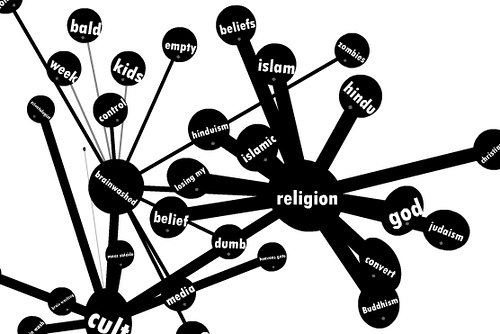
 Sometimes a matter of making things interesting rather than boring. One may take a measure of the other person, of their sensibilities and their sophistication. But one also needs to draw a line,to reach conclusions readily, correctly, avoid dilly-dallying, tell it as it comes even when it is not how things originally appeared, by a good preacher, not a yawning lecturer. Such doubts mostly concern personal experiences and do not apply to reporting “objective” matters.
 But beliefs, like pearls, differ in brightness, size, and other properties and some beliefs are more intensely believed than others. Also different beliefs held may be coherent, that is, constitute a web of beliefs and therefore have a demonstrable structure which relate them to each other or which like pearls lie separately yet waiting to be arranged into one or more pieces of jewellery.
 Facts and their properties have occupied my thinking for much of the past year. I have suggested that our current term *fact* needs to be supplemented by terms that express the idea that many facts have lost their credentials and have been dishonourably discharged: what these assert no longer is so.
 The history of comets is a case in point. Comets had been reported for thousands of years by both Eastern and Western sky-watchers, but were thought to be aberrations from a pre-ordained order of things,that portended unusual events, like the birth and death of prominent people, (e.g., Caesar’s death, Macbeth’s kingship, Caliban’s fate – Shakespeare was well versed in the Occult), or generally boded good or ill. But where did comets come from, and how did they travel in the sky? This was a specially difficult problems to answer if one assumed – as was common for thousands of years – that celestial bodies travelled around the earth on fixed translucent platforms, perhaps on impenetrable glass discs, each “nailed” permanently to a wall in the sky.
 The term *factoid* was coined by Norman Mailer to express the idea that many things we believe to be true — and which normally go unchallenged — are products of the public media (radio, TV, newspapers, advertisers). Factoids are therefore statements made by the media and are about states of affairs. The statements are supposedly correct, or largely true. The media who circulate these may have other motives than keeping the public well-informed. According to Norman Mailer, they often (too often) pervert truth and do so for entirely self-serving reasons.
 Note: It is not the statement that is fallible or infallible, but the person who makes the statement. I personally do not know of anyone who is a specialist in infallible statements – although I know many who ACT AS IF they were. It is a self-description, an affectation at worst. Some people, in moments of hero-worship, may claim that Mr. X or Miss Y is always correct in what they say or claim. But this only passes the buck. The person making such a claim is obliged to demonstrate that the claim itself is always true – that indeed it is they that are infallible in their judgements. It has nothing to do with any particular fact and its truth-value.
 Facts should carry date-marks so that we can know when and by whom these were approved. This practice — if religiously observed — would remind us again and again that facts are not infallible, not forever, not unchangeable, but bear the stamp of human approval and not divinity. Furthermore facts are subject to change, can become factoids.